Showing posts with label marble sink. Show all posts

Saturday, October 10, 2026

Filled vs Unfilled Travertine Sinks: What to Ask Before Ordering

A practical material-selection guide by MarbleSinkCo.

A travertine sink can bring warm colour, visible pores and carved texture into a bathroom. Those same details make a close look at the finish worthwhile before ordering. Is the washing bowl filled? Does the outer apron retain open texture? What exactly does “honed” describe? The most useful answer identifies each surface of the actual basin.

This guide explains filled and unfilled travertine, separates filling from finishing and sets out questions for a custom order. It does not assign a filling treatment to a photographed product: that detail should be confirmed with the workshop for the piece you intend to buy.
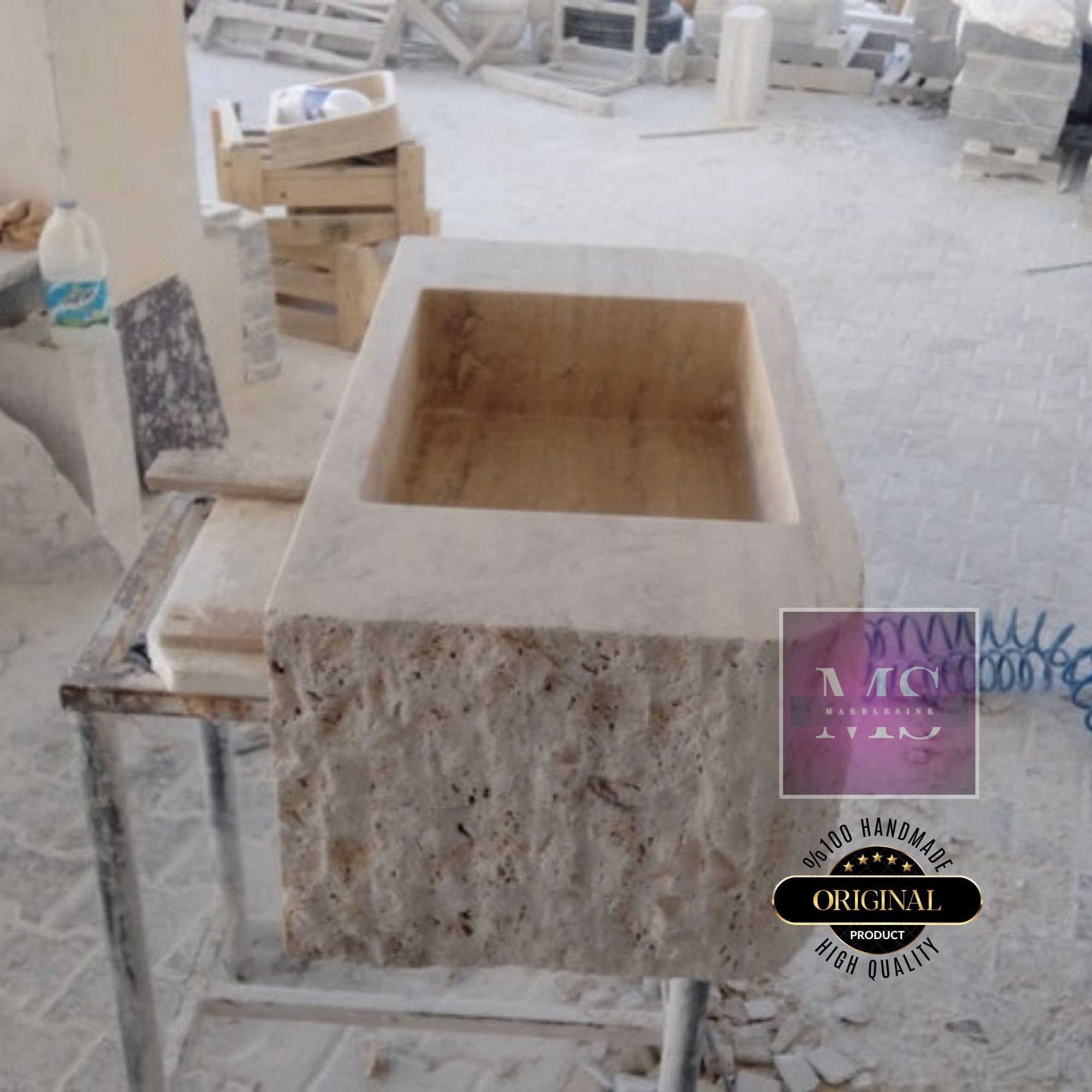
MarbleSinkCo rough-chiseled travertine basin showing its textured stone front

Genuine MarbleSinkCo product photograph from our rough-chiseled travertine basin listing. The image illustrates exterior texture; it does not establish the filling treatment of every surface.

What does filled or unfilled travertine mean?

Travertine naturally contains voids. The Natural Stone Institute explains that openings exposed at a stone surface may be filled during fabrication or left open. Filling materials can be cement-based or resin-based. Filling the exposed face does not eliminate every internal void in the stone.

For a sink, ask which exposed areas receive that treatment. “Filled travertine” is a starting description, but it may not answer whether the bowl, rim, deck, sides and front are treated alike. “Unfilled” likewise needs context: which areas retain open pores, and how does the supplier intend them to be used and maintained?

The Institute's Travertine Voids handout explains the material characteristic using flooring examples. Its discussion helps explain the stone; it is not an installation specification for a basin.

Filling, honing and carving are different decisions

Do not treat filled, honed and chiseled as interchangeable labels. Filling describes the treatment of surface openings. Honing describes a surface finish. Carving describes the geometry or texture created in the stone. An order description should resolve these separately rather than leave the buyer to infer one from another.

A useful enquiry might read: “We like a textured front, but please explain the proposed treatment of the washing bowl and faucet deck.” This lets the workshop address function and appearance independently. If the reply only describes the front, ask for the remaining faces to be recorded on the drawing or written specification.

Start with the washing bowl, then review the exterior

Look first at the surfaces used during washing. Ask for clear close-ups of the bowl, rim and drain area rather than relying entirely on a dramatic front view. The washing surface and a decorative apron have different roles, so a decision based only on the apron leaves an important part of the order unresolved.

Discuss where water, soap and cosmetics are likely to sit. A supplier should explain the cleaning method intended for each surface, including any open texture. Do not assume that an attractive rustic exterior means that the interior must have the same treatment, or that a smooth-looking photograph proves a fully filled surface.

If textured stone is part of the brief, describe where that texture matters visually. A front face seen from the doorway may deserve a different conversation from a narrow side beside a wall. Confirm the visible faces before selecting a reference photograph.

Ask what the sample can actually tell you

A close-up helps explain colour, pore distribution and surface appearance. It cannot show every part of a future basin. Ask whether a supplied photograph shows the exact piece, an example of the material or an example of the proposed finish. Those are useful references, but they answer different questions.

Where a sample is available, establish whether it represents the treatment proposed for the bowl or only the exterior. Review it under the room's intended lighting and beside the wall and faucet finishes. Keep the approved reference with your order notes so the discussion remains anchored to an identifiable example.

Natural variation should be expected. If a particular pore pattern or visual balance is essential, state that priority early and ask what approval process is feasible. Avoid describing a reference image as a guarantee that another piece will repeat it exactly.

Make the care discussion specific to the finish

Ask for written care instructions that cover the stone, any filler and the chosen finish together. The Natural Stone Institute recommends gentle cleaning suited to natural stone and cautions that acidic products can damage calcareous materials. It also explains that sealing improves stain resistance rather than making stone stain-proof.

For a custom basin, useful questions include which cleaner to use, how to maintain textured areas and when the surface or protective treatment should be reviewed. Ask the supplier before using an unfamiliar descaler or attempting to repair a pore. A generic bathroom-cleaning label does not establish compatibility with the finished basin.

For general background, consult the Institute's natural stone care guidance. For a basin-focused checklist, use our travertine sink care guide and confirm the final routine for your order.

Write a surface-by-surface order brief

A short surface schedule makes the discussion easier to review. List the bowl, rim or deck, front apron, exposed sides and backsplash if present. For each one, ask the workshop to record the intended finish and whether exposed openings are filled, retained or treated in another agreed way.

Add the overall dimensions and usable bowl dimensions separately. Identify the faucet arrangement and drain fitting. Then ask the installer to review support, plumbing and access for the actual room. A decision about pore filling does not answer whether a wall or cabinet can support the basin.

Our Natural Stone Sink Specification Center provides a structure for that broader brief.

Questions to send before approving fabrication

  • Which surfaces will be filled, and which will retain open texture?
  • What filling material is proposed where filling is used?
  • Does the reference show the actual piece or an example?
  • What finish is specified for the bowl, deck and visible exterior?
  • Which cleaning products and tools are appropriate for that treatment?
  • How should a change in a filled area be assessed later?
  • Where will the final surface schedule and approved references be recorded?

Frequently asked questions

Is filled travertine the same as sealed travertine?

No. Filling and sealing address different things. Filling treats exposed openings; sealing is a protective treatment whose suitability should be confirmed for the stone and use. Ask about both independently.

Does a rough-chiseled front mean the bowl is unfilled?

No. An exterior finish description does not establish the bowl treatment. Request photographs and a written answer for the interior and drain area.

Can a photograph prove that a sink will be easy to maintain?

A photograph explains appearance. Maintenance depends on the actual surfaces, their treatment and the care routine. Request those details before deciding.

What should I do if a filled area changes after installation?

Photograph the area and contact the supplier or a qualified stone professional. Ask for an assessment before applying a repair product or more aggressive cleaner.

Explore a travertine basin for your bathroom

Compare forms and materials at MarbleSinkCo's natural stone sink collection. To request a custom quote, send your preferred reference, dimensions and surface questions through our rough-chiseled travertine basin listing on Etsy. Confirm the filling treatment, inclusions and current order terms in writing before approving the piece.

About MarbleSinkCo: We produce custom natural-stone pieces in Türkiye. This article is planning guidance; site-specific support, plumbing and installation should be reviewed by qualified local professionals.

Saturday, October 3, 2026

How to Choose a Marble Sink for a Small Powder Room

A practical planning guide from MarbleSinkCo.

A small powder room gives a natural stone sink a prominent role. The basin, faucet and mirror may be the first things a guest notices, but a successful design starts with everyday use. A beautiful marble sink should leave enough space to move, keep water inside the bowl and work with the plumbing and structure already in the room.

This guide explains how to choose a marble sink for a small powder room and which details to confirm before commissioning a custom stone basin.

1. Measure the room before choosing the sink

Start with a simple plan showing the door swing, toilet, existing plumbing and available wall width. Measure the space in front of the proposed sink as well as the distance to nearby fittings. A photograph can help explain the room, but it should accompany measurements rather than replace them.

Sink width is only one part of the decision. Projection from the wall can be more important in a narrow room. Mark the proposed outline on the floor with tape or use a cardboard template to see how the basin will affect movement. Check applicable local clearance requirements with your installer.

Record the external length, width and height separately from the internal bowl dimensions. Two sinks with similar outer dimensions can have very different usable bowls because of their rim thickness and carving.

2. Compare wall-mounted and countertop designs

A wall-mounted marble sink leaves the floor visible and can give a compact room a lighter appearance. It also exposes more of the plumbing unless that plumbing is carefully positioned. Decide early whether the drain and trap should be visible, coordinated with the faucet finish or concealed through an appropriate design.

A countertop basin can work well when storage is a priority. The cabinet, countertop and sink need to be planned together, including the finished rim height and access for plumbing. Adding a vessel basin to an existing vanity can raise the washing surface more than expected.

Neither arrangement is automatically the better choice. Compare the room's storage needs, wall construction, plumbing position and maintenance access before selecting the installation style.

3. Match the faucet to the usable bowl

Choose the faucet before fabrication. Its reach, outlet height and water flow influence where water lands and how much it splashes. A faucet that looks proportional in a photograph may send water too close to the rim when paired with a shallow bowl.

Give the fabricator the actual faucet specification rather than an approximate description. For deck-mounted taps, confirm the hole count, diameter, spacing and edge offsets. For wall-mounted taps, coordinate the outlet with the sink's final height and internal bowl geometry.

Ask the plumber to review the faucet and basin together. Confirm the drain fitting, trap clearance and whether the selected basin has an overflow. These details should be settled before the stone is cut.

4. Review the structural support

Natural stone is heavy, and the finished weight depends on the material and design. A wall-mounted stone basin needs a support strategy verified for the actual wall, backing, anchors and installation. The basin's weight is only part of the load that the support must accommodate.

Ask a qualified local installer to review the proposed piece before ordering. Do not assume that decorative finishes or ordinary plasterboard provide the required support. If brackets are used, confirm their dimensions, placement and visibility from normal viewing angles.

For a countertop installation, verify that the cabinet and supporting surface are suitable. Keep an accessible route to the plumbing so future maintenance does not require unnecessary stone removal.

5. Choose the stone's visual character

Carrara marble is often chosen for its pale background and grey movement. Calacatta Viola provides a more expressive focal point, while travertine introduces warm tones and a different surface character. Travertine is a natural stone distinct from marble, so compare the specified finish and filling treatment as well as the colour.

Look at photographs of the actual material available for your project whenever possible. Natural veining, tonal variation and mineral features are part of the stone's character. A reference photograph explains the direction, but it cannot promise an identical pattern in a different piece.

In a compact room, compare the sink with the wall finish, floor and lighting. One expressive stone element may be enough to establish the room's identity without adding several competing patterns.

6. Plan realistic care from the beginning

Marble and travertine need care suited to their material and finish. Use a cleaner intended for the specified natural stone, follow the supplier's care instructions and wipe away spills promptly. Avoid acidic products such as vinegar and unsuitable abrasive cleaners.

Sealing can help reduce absorption, but it does not make stone immune to stains or acid etching. The appropriate sealer and maintenance interval depend on the stone, finish, product and use. Ask for written care guidance rather than relying on a universal yearly schedule.

Think about everyday items too: soap, cosmetics and cleaning products should be stored so leaks do not sit on the surface. A manageable care routine helps preserve the appearance without making the powder room difficult to use.

7. Put the custom order in writing

Before approving fabrication, assemble a short project brief: external dimensions, internal bowl size, installation style, stone and finish, faucet specification, drain position and delivery destination. Include photographs and a dimensioned drawing where useful.

Confirm what the price includes. Faucets, drains, brackets, furniture and decorative accessories may be separate. For international delivery, clarify packaging, receiving arrangements, access, unloading responsibilities and any applicable import charges. Production and transport estimates should be confirmed for the particular order.

A simple checklist before ordering

  • Test the sink's projection and the door swing in the room.
  • Confirm both external and internal bowl dimensions.
  • Have the faucet, drain and plumbing reviewed together.
  • Get professional confirmation of the supporting structure.
  • Approve the material direction, finish and written care guidance.
  • Confirm inclusions, delivery arrangements and the final drawing.

Explore a basin for your project

MarbleSinkCo creates handcrafted natural stone pieces in Türkiye for projects worldwide. Compare wall-mounted and countertop directions in our custom marble sink collection.

To discuss dimensions, material availability and current order terms, visit the MarbleSinkCo Etsy shop and send your room measurements with the closest product reference. Confirm the final specification in the written order conversation before production.

Saturday, July 18, 2026

Calacatta Viola Fluted Marble Sink: Wall-Mounted Luxury Basin Hand-Carved in Turkiye


 https://marblesinkco.etsy.com/listing/1679501534/calacatta-viola-marble-sink-wall-mount / Not just a sink — a piece of architecture carved from natural stone.

Hand-carved from genuine Calacatta Viola marble, this fluted wall-mounted basin features dramatic burgundy veining, a deep rectangular bowl and a sculptural facade.

Every sink is individually made to order by MarbleSinkCo artisans and can be customized for your project.

Available external sizes:
30–100 cm / 11.8–39.4 in

Perfect for:
• Luxury powder rooms
• Boutique hotels
• Villas and penthouses
• Interior design projects
• Custom bathroom renovations

Worldwide insured delivery in a reinforced wooden crate.

Discover the complete product and available sizes through the link in our bio.

Designed and handmade by MarbleSinkCo / #CalacattaViola #MarbleSink #WallMountedSink #FlutedMarble #PowderRoomDesign #LuxuryBathroom #BathroomDesign #InteriorDesign #InteriorDesigner #CustomVanity #NaturalStoneDesign #MarbleBathroom #BoutiqueHotelDesign #HospitalityDesign #MarbleSinkCo 


https://marblesinkco.etsy.com/listing/1679501534/calacatta-viola-marble-sink-wall-mount

Monday, March 9, 2026

Suspended Calacatta Viola Marble Sink, Chain Mounted Floating Vanity, Hand Carved Luxury Bathroom Basin

https://marblesinkco.etsy.com/listing/4468356230/suspended-calacatta-viola-marble-sink / #luxurybathroom #travertinesink #floatingvanity #bathroomdesign #interiordesign #architecture #architecturaldesign #stonedesign #naturalstone #luxuryinteriors #villadesign #penthouseliving #bathroominspiration #moderninterior #designerbathroom #stonecraft #artisanmade #luxuryhomes #architecturalpiece #interiorinspo


"Chiseled Travertine Suspended Sink, Rustic Floating Vanity, Luxury Stone Bathroom Basin, Statement Piece 10" "Chiseled Travertine Suspended Sink, Rustic Floating Vanity, Luxury Stone Bathroom Basin, Statement Piece 1" "Chiseled Travertine Suspended Sink, Rustic Floating Vanity, Luxury Stone Bathroom Basin, Statement Piece 2" "Chiseled Travertine Suspended Sink, Rustic Floating Vanity, Luxury Stone Bathroom Basin, Statement Piece 3" "Chiseled Travertine Suspended Sink, Rustic Floating Vanity, Luxury Stone Bathroom Basin, Statement Piece 4" "Chiseled Travertine Suspended Sink, Rustic Floating Vanity, Luxury Stone Bathroom Basin, Statement Piece 5" "Chiseled Travertine Suspended Sink, Rustic Floating Vanity, Luxury Stone Bathroom Basin, Statement Piece 6" "Chiseled Travertine Suspended Sink, Rustic Floating Vanity, Luxury Stone Bathroom Basin, Statement Piece 7" "Chiseled Travertine Suspended Sink, Rustic Floating Vanity, Luxury Stone Bathroom Basin, Statement Piece 8" "Chiseled Travertine Suspended Sink, Rustic Floating Vanity, Luxury Stone Bathroom Basin, Statement Piece 9"


 https://marblesinkco.etsy.com/listing/4468759492/travertine-suspended-sink-floating-stone / #luxurybathroom #travertinesink #floatingvanity #bathroomdesign #interiordesign #architecture #architecturaldesign #stonedesign #naturalstone #luxuryinteriors #villadesign #penthouseliving #bathroominspiration #moderninterior #designerbathroom #stonecraft #artisanmade #luxuryhomes #architecturalpiece #interiorinspo

Thursday, January 15, 2026

19" Natural Travertine Drop-In Bathroom Sink (Hand-Carved Real Stone)

19" Natural Travertine Drop-In Bathroom Sink (Hand-Carved Real Stone)
• 3 faucet holes (centerset)
• Centered drain
• No overflow hole

Shop:
https://marblesinkco.etsy.com/listing/4441645345/19-inch-natural-travertine-drop-in-sink?utm_source=youtube_shorts&utm_medium=social&utm_campaign=travertine_dropin_19in

#travertine #bathroom #interiordesign #stonesink #shorts

Sunday, November 30, 2025

What’s the real difference between honed, polished, leathered and brushed finishes?

​Yesterday I shared how natural stone like marble, travertine and granite actually form in nature.

Today, I wanted to continue with something designers ask me the most:


What’s the real difference between honed, polished, leathered and brushed finishes?


Here’s a quick breakdown from a stone craftsman’s perspective:


✨ Polished


• Glossy, mirror-like surface

• Highlights the veining dramatically

• Best for: luxury bathrooms, vanities, hotels


✨ Honed


• Matte, soft finish

• More modern and minimal

• Less slippery than polished

• Best for: contemporary bathrooms, floors


✨ Leathered


• Textured, tactile surface

• Hides fingerprints incredibly well

• Gives stone a warm, natural depth

• Best for: countertops, feature walls


✨ Brushed


• Softly textured with subtle movement

• Very natural look

• Works beautifully on travertine

• Best for: rustic or Mediterranean style spaces


Why this matters for interior design:


Choosing the right finish can completely change how a bathroom or countertop feels — not just visually but emotionally.

Same stone, four finishes → four different moods.


If anyone wants, I can also share examples of how each finish reacts to light & shadow.


— Maat (stone craftsman)


“A quick guide on how natural stone and marble actually form — from a stone craftsman’s perspective”

​Did you know that every piece of marble carries millions of years of history?

Not just a surface… but a geological story created by heat, pressure and time. 💎


Here’s a quick, fascinating breakdown for anyone who loves interior design, architecture or natural materials:


🪨 

How Marble Forms


Marble starts as limestone.

Over millions of years, intense heat + pressure inside the earth transform it into marble.

That’s how Calacatta, Carrara and Viola marbles get their dramatic veins — they’re literally the result of tectonic movement.


🪨 

How Travertine Forms


Travertine grows near hot springs.

Water flows, minerals build up, layer by layer…

That’s why it has natural holes and a soft, organic texture.


🪨 

How Granite Forms


Granite forms deep underground when magma cools extremely slowly.

The slow cooling allows crystals to grow, making granite incredibly strong.


🪨 

Why Colors & Veins Differ


Different minerals create different looks:

• iron → gold/brown tones

• graphite → grey/black

• copper → green

• clay → beige/cream


Every stone block is unique because nature is unique.


✨ 

Why Designers Love Natural Stone


Because no engineered material can replace:

✔ real geological depth

✔ natural movement

✔ unique veining

✔ timeless luxury

✔ emotional texture


When you place a real marble piece in your home, you’re literally placing a piece of the Earth’s history.


If you’d like, I can prepare a guide explaining the difference between:

• honed

• polished

• leathered

• brushed

stone finishes.


Just comment “Guide” below and I’ll send it! 🔽💬


Filled vs Unfilled Travertine Sinks: What to Ask Before Ordering

A practical material-selection guide by MarbleSinkCo. A travertine sink can bring warm colour, visible pores and carved texture into a bath...